
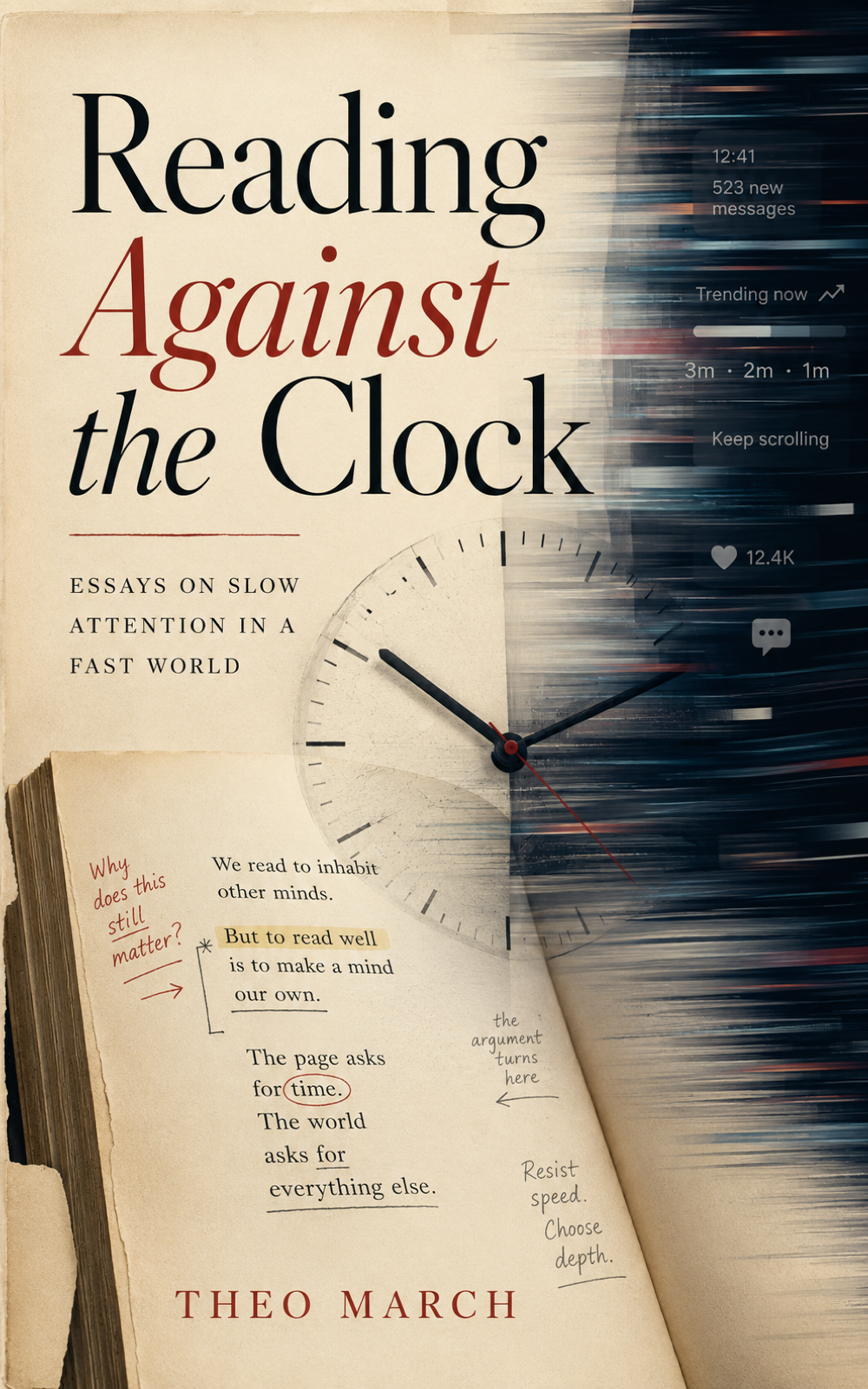
The premise of Reading Against the Clock is immediately inviting: Essays on rereading, digital distraction, translation, book clubs, annotation, and the social life of literary judgment. Yet Theo March is not satisfied with premise alone. The book steadily turns its situation toward what readers owe books, communities, and their own limited attention, The ambition is apparent, but the book repeatedly mistakes a suggestive setup for fully developed drama.
The strongest element is the book’s control of form. March moves easily from close reading to cultural criticism, keeping the personal essays open to disagreement. That local ingenuity never becomes a reliable method. The book repeatedly substitutes arrangement for development: clues, images, and reversals are placed where they are expected, but they do not accumulate enough pressure to alter the reader’s understanding. What initially appears controlled gradually feels overmanaged.
The characters suffer most from that approach. Decisions are frequently made because the plot requires a reveal or confrontation, not because the people involved have been given persuasive motives. Secondary figures are reduced to functions, while the central relationships move between intimacy and hostility with too little connective tissue. The emotional logic is therefore asserted more often than it is demonstrated.
March can produce an arresting image, but the prose strains to maintain importance around every scene. Metaphors recur after their meaning is clear, dialogue carries explanatory burdens it cannot disguise, and summary often arrives where dramatization is needed. Concrete detail supplies occasional texture, yet it cannot create depth on its own.
As a work of essays & criticism, the book leans heavily on familiar machinery without using it to generate a distinctive point of view. The conventions are not the problem; the problem is that they function as shortcuts. Comparisons to stronger examples of the form become unavoidable because the narrative borrows their shapes without matching their precision, surprise, or psychological credibility.
The recurring defense of slowness occasionally becomes repetitive. Rather than standing alone, this flaw becomes a clear symptom of the larger construction. The book has difficulty deciding what information to withhold, what to repeat, and what consequences its own revelations should produce. Each imbalance weakens the next, so the final act must explain and resolve more than the preceding chapters have prepared.
The closing movement amplifies those problems. Resolution arrives through compressed explanation, abrupt changes of mind, or symbolic gestures whose meanings have already been announced. There are pockets of skill, and the premise may still appeal to readers drawn to the subject, but Reading Against the Clock does not build a convincing path from its opening promise to its final claims.
Verdict
Our verdict: Moments of atmosphere survive, but repetition and schematic plotting drain this essay collection of urgency. At 2.5 out of five stars, it contains notable ideas and occasional skill, but its major weaknesses in structure and characterization ultimately outweigh those virtues.
Book details
- Publisher
- Margin & Field
- Publication date
- 2026