
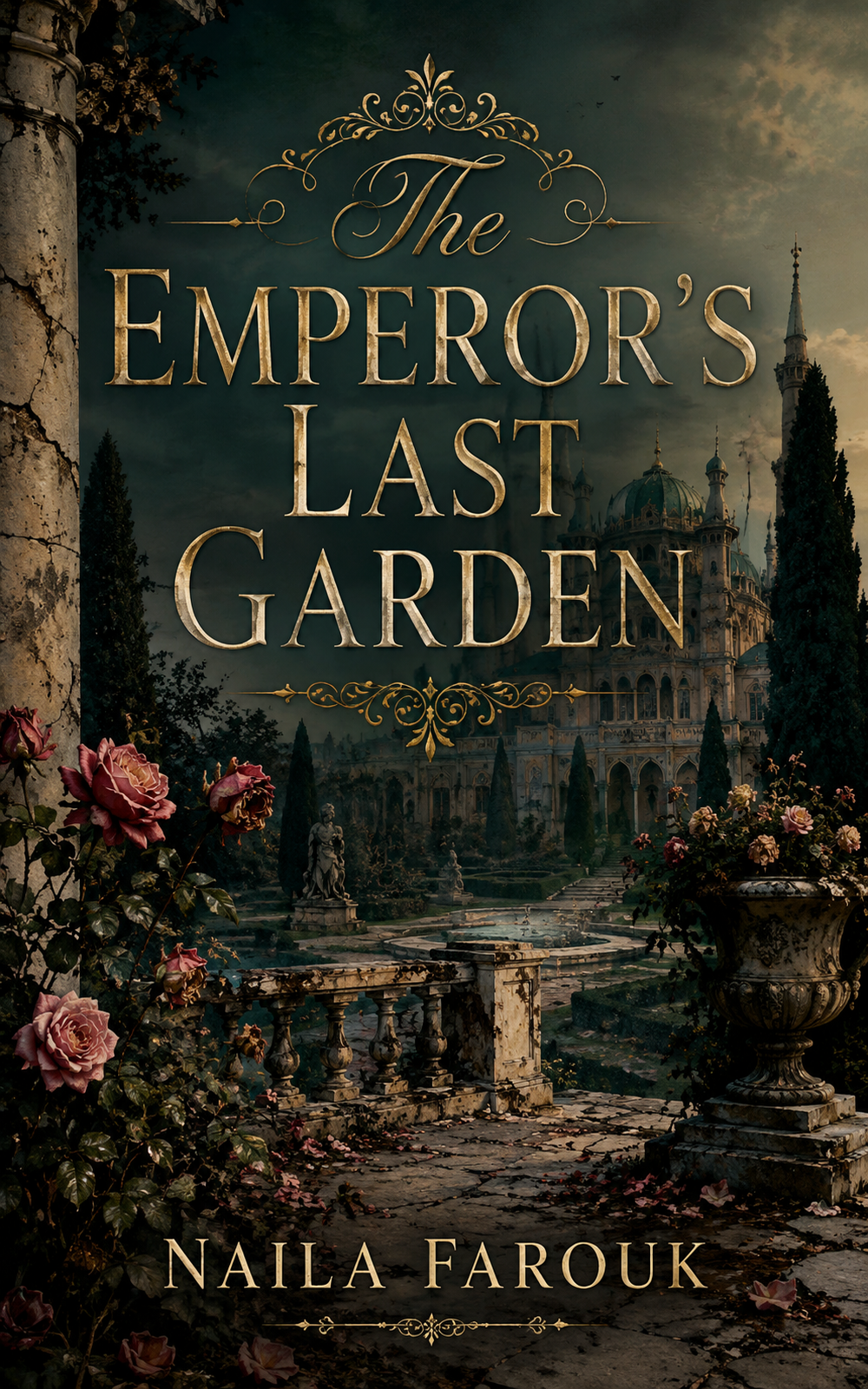
Naila Farouk sets The Emperor’s Last Garden in the final months of a fictional nineteenth-century court, where botanist Layla Anwar is commissioned to preserve an imperial garden before invading forces reach the capital. She discovers coded messages hidden in planting diagrams and becomes entangled in a struggle among reformers, royal relatives, foreign diplomats, and the emperor’s chief gardener. The premise offers rich possibilities for political and ecological history.
The novel’s visual imagination is considerable. Farouk describes irrigation channels, seed vaults, painted pavilions, and imported plants with evident research and enthusiasm. Individual objects are often memorable, particularly a greenhouse repaired with fragments of colored palace glass. The garden could have served as a powerful model of the empire itself: beautiful, extractive, carefully ordered, and dependent on invisible labor.
Instead, description repeatedly replaces drama. Long passages explain the origin and symbolic meaning of each plant before characters are allowed to act. Conversations pause for historical summaries that no participant would need, and the narrative introduces political factions through paragraphs of background rather than conflict. The book is full of information but rarely creates the pressure that would make that information matter.
Layla remains frustratingly passive. Although she is presented as an expert, crucial discoveries occur because she overhears convenient conversations or receives documents from more active characters. Her botanical knowledge solves one early problem and then becomes largely decorative. The court figures around her are divided into transparent heroes, decadent aristocrats, and calculating foreigners, leaving little room for competing loyalties or credible self-deception.
The intrigue is equally mechanical. Codes are solved immediately after their necessary clue appears, secret passages connect whatever locations the plot requires, and betrayals are signaled so heavily that the characters’ surprise becomes difficult to believe. A late romance develops through declarations rather than accumulated intimacy, apparently included to raise the personal stakes before the siege.
Farouk’s prose can be lush, but it frequently overmodifies images. Nearly every room glows, trembles, sighs, or remembers. The effect is less atmospheric than exhausting, especially during action scenes that need clarity. Repeated references to the garden as the empire’s “living heart” state a symbolism the novel has already made obvious.
The conclusion compresses military collapse, romantic sacrifice, and the garden’s destruction into a few melodramatic chapters. Because the political and personal relationships have not been fully developed, the losses register as planned effects rather than consequences. The final image is attractive, but it cannot redeem the novel’s structural and character failures or make its elaborate research feel dramatically necessary.
Verdict
Our verdict: An ornate historical saga weighed down by exposition, implausible intrigue, and characters treated as pieces in a decorative design. At 1.5 out of five stars, it offers attractive surfaces but little persuasive life beneath them.
Book details
- Publisher
- Crown Meridian
- Publication date
- 2025