
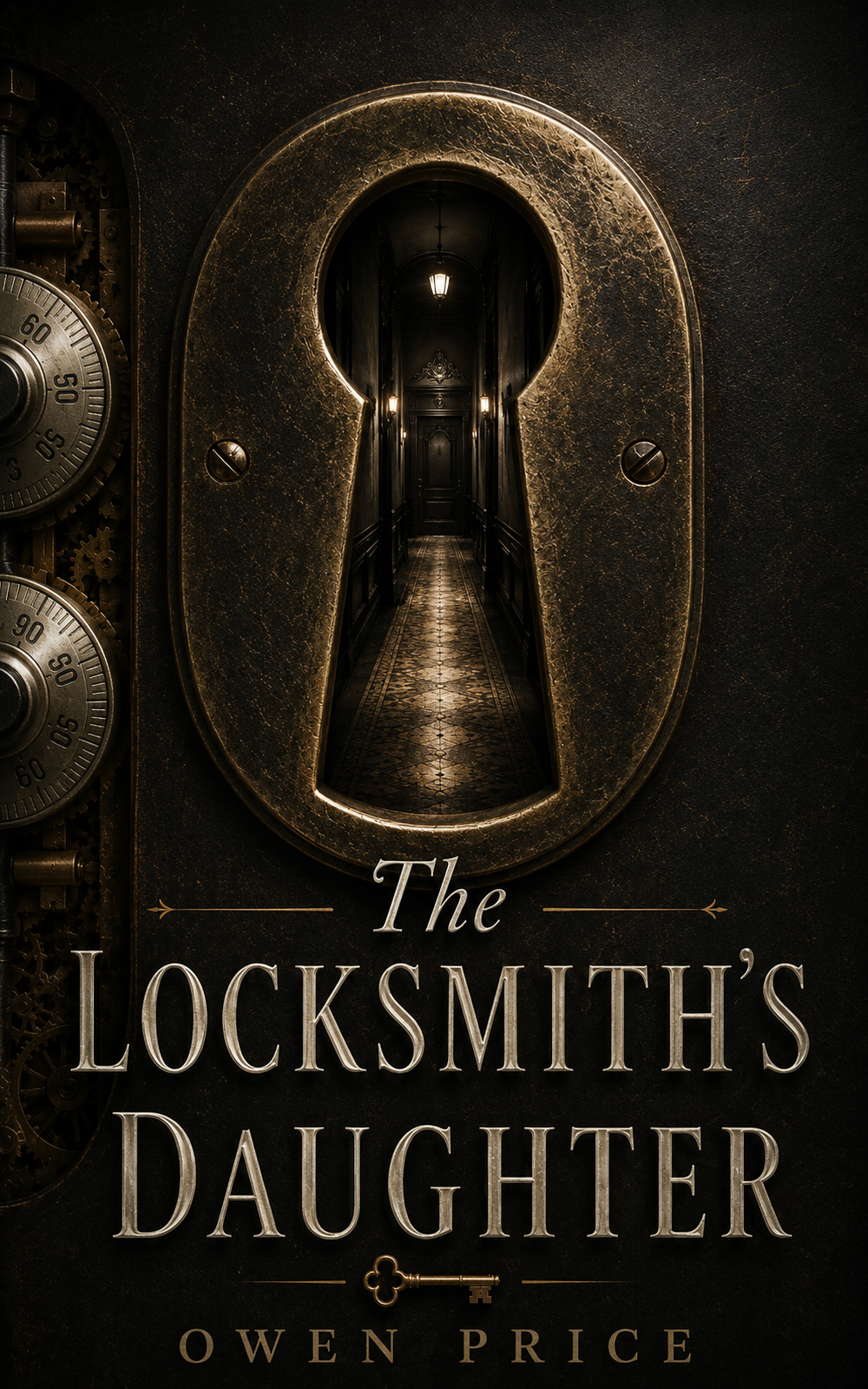
Owen Price gives The Locksmith’s Daughter an efficient hook. Mara Vick, who grew up repairing locks in her father’s shop, is asked to open a safe recovered from a demolished hotel. Inside she finds a recent photograph of her father, who has been missing for twelve years, standing beside a murder victim. The discovery sends Mara through old service corridors, private vaults, and a network of collectors who trade in keys connected to famous crimes.
The material should be irresistible. Price knows enough about locks to make their operation tactile, and the early chapters use professional detail well. Mara listens for pins, studies wear patterns, and reads a damaged key as evidence of how its owner moved. The novel briefly suggests that access itself will become its central subject: who is permitted entry, who controls secrecy, and whether opening something creates responsibility for what is found.
Those ideas are soon crowded out by plot. Every locked object contains another clue, and nearly every clue points to a new location before the current one has acquired meaning. The book moves quickly, but speed is not the same as suspense. Because revelations arrive on schedule and rarely alter Mara’s understanding of herself, the story feels assembled rather than discovered.
Mara is defined almost entirely by competence and anger. Her missing father remains an abstract wound, while their shared history is delivered through repeated memories of the same workshop lesson. Supporting characters are thinner still. A journalist provides exposition, a detective alternates between obstruction and assistance, and the primary villain speaks in polished explanations that announce importance without creating personality.
The prose is functional and occasionally vivid when Price returns to tools and mechanisms. Elsewhere it leans on familiar noir shorthand: rain on windows, expensive shoes in dirty alleys, smiles described as blades. These phrases maintain tone but do not build a distinctive city or social world. The hotel at the center of the mystery never becomes more than a sequence of atmospheric rooms.
The final twists are especially damaging. One character’s identity depends on information deliberately withheld from Mara’s point of view, and the father’s disappearance is explained through a conspiracy broader than the novel can support. Instead of reinterpreting earlier scenes, the solution adds new facts late and asks surprise to substitute for coherence.
A more patient version of this book might have turned locksmithing into a powerful moral and formal principle. The published novel uses it mainly as decoration for a chain of conventional reversals. There are moments of craft, but they cannot unlock the emotional or thematic depth the premise promises.
Verdict
Our verdict: A stylish crime premise trapped inside mechanical plotting, thin motives, and twists that arrive louder than they land. At 2.0 out of five stars, it is readable in motion but increasingly unconvincing whenever the machinery of the mystery becomes visible.
Book details
- Publisher
- Black Brass Press
- Publication date
- 2025